Nvidia beat by $6.7 billion and fell anyway: what $10 a day in NVDA did
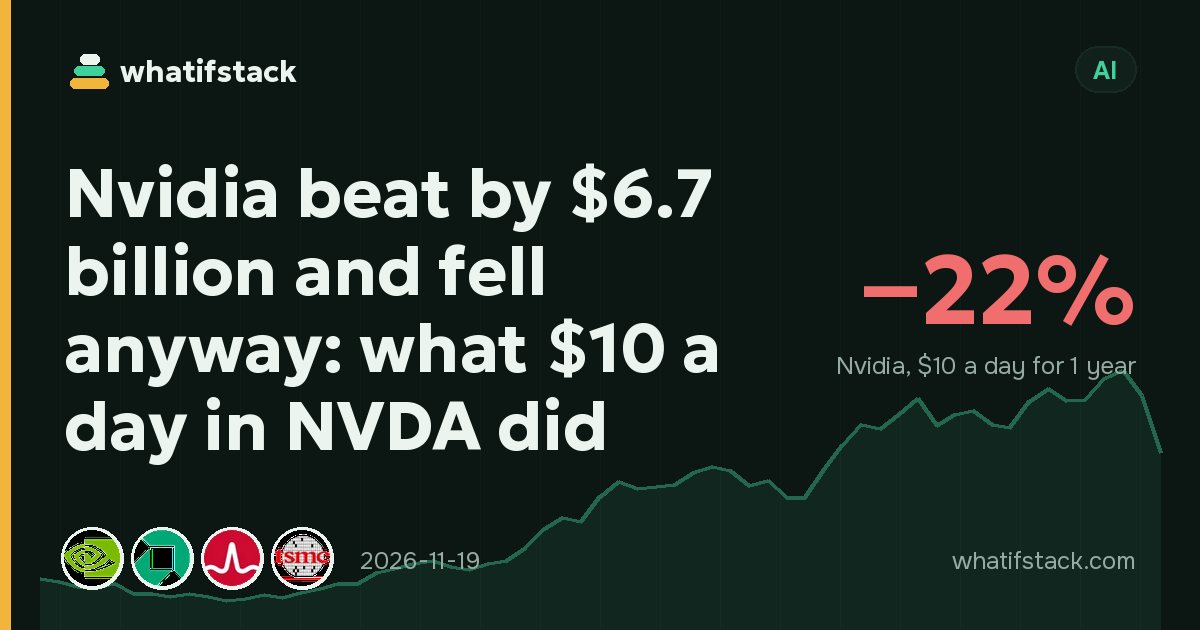
Nvidia reported $115.8 billion of quarterly revenue on Tuesday, about $6.7 billion more than analysts expected, and forecast $130 billion for the next quarter. The stock rose about 2% after hours, then fell about 2.5% on Wednesday. Today it trades at $145.98, roughly 35% below its October peak near $240. Why do great numbers not lift the share price, and what does this mean for people who buy a little every month?
Key takeaways
- Revenue doubled (+103% a year) and data-centre sales hit $107.6 billion, yet Nvidia fell after its report, as it did after a "historic" beat in February.
- On our data, $10 a day in Nvidia over the past year is worth $2,752 (−24.6%) on $3,650 invested.
- Over 5 years the same habit is worth $59,734 (+227%): the long run still looks very different from the last twelve months.
The numbers were huge again
The quarter ended on 25 October. Nvidia's revenue was $115.8 billion, up 103% from a year earlier and 20% from the previous quarter. Data-centre revenue, the AI chips that cloud companies and AI labs buy, was $107.6 billion, about 93% of all sales. Net income more than doubled to $65.3 billion, and adjusted earnings per share of $2.68 beat the roughly $2.47 analysts expected.
The outlook was also above forecasts: about $130 billion for the current quarter, against around $125 billion expected, with no data-centre sales to China assumed. Nvidia said its new Vera Rubin systems have started shipping, and it returned $28.1 billion to shareholders through buybacks and dividends in the quarter.
This was the first report since Jensen Huang resigned as CEO on 12 November. Interim CEO Colette Kress, previously the finance chief, said the company's momentum is real and the product roadmap is on track.
"Sell the news" is not new for Nvidia
When a stock is owned by almost every fund, good results are often already in the price. What moves it is the gap between the numbers and what investors hoped for, and that bar is very high for Nvidia.
- February 2026: after what Morgan Stanley called a historic beat-and-raise, the shares fell more than 4% at the next open.
- August 2026: the stock first dipped after hours, then rose about 4% once management said it expected about 70% revenue growth in the next fiscal year.
- November 2026: up about 2% after hours, down about 2.5% the next day, even though the growth target for the next fiscal year was lifted to 75%.
A beat is the minimum, not a surprise. One quarter's reaction tells you little about where a stock goes over years.
Why investors sold this time
There is no single official reason, but several worries came up in the coverage:
- Margins. Nvidia guided gross margin to 71–72% for next quarter, down from 74.8%. Still very high, but going the wrong way.
- Who pays for the chips. In August Nvidia announced platforms with Apollo, BlackRock, Blackstone, Brookfield, Goldman Sachs and KKR to mobilise over $500 billion of outside money to finance AI computing. On Wednesday the Wall Street Journal reported that no capital has actually been deployed yet, and Kress said Nvidia will be more disciplined about financing customers. When a chip seller helps its buyers borrow, critics see an echo of the dot-com era.
- Leadership. The company lost its founder-CEO a week before the report and is still searching for a permanent replacement.
- Competition for attention. Anthropic priced its IPO at $83 a share, above its $70–78 range, and starts trading on Nasdaq today. AMD, meanwhile, is up about 140% over the past year on our data while Nvidia is down about 15%.
What it means if you buy regularly
DCA (dollar-cost averaging) means buying a fixed amount on a schedule, whatever the price. It does not care about one earnings day, but it does show who has been rewarded so far. Here is $10 a day over one year in the main AI chip names:
| Asset | Invested | DCA · 1 year | Result | $1,000 1 year ago |
|---|---|---|---|---|
| Nvidia | $3,650 | $2,752 | −24.6% | $826.72 |
| AMD | $3,650 | $5,345 | +46.4% | $2,249 |
| Broadcom | $3,650 | $3,539 | −3.04% | $866.66 |
| TSMC | $3,650 | $3,393 | −7.04% | $1,221 |
| Semiconductors (VanEck) | $3,650 | $3,420 | −6.31% | $1,274 |
| S&P 500 ETF | $3,650 | $3,641 | −0.24% | $1,059 |
The one-year picture is hard on Nvidia: $3,650 became $2,752 (−24.6%), because the stock is lower than for most of the past year. Over three years, $10 a day in Nvidia returned +13.5%, close to the S&P 500's +19.3%. That is a surprising sentence for the world's leading AI chip company, and a reminder that buying at the height of excitement drags on results for a long time.
Zoom out to five years and the story flips:
| Asset | Invested | DCA · 5 years | Result | $1,000 5 years ago |
|---|---|---|---|---|
| Nvidia | $18,260 | $59,734 | +227% | $4,487 |
| AMD | $18,260 | $68,982 | +278% | $3,089 |
| Broadcom | $18,260 | $61,404 | +236% | $6,840 |
| Microsoft | $18,260 | $25,810 | +41.3% | $1,571 |
| Nasdaq-100 ETF | $18,260 | $28,087 | +53.8% | $1,688 |
$10 a day in Nvidia since November 2021 is worth $59,734 (+227%) on $18,260 invested. Someone who kept buying through the 2022 crash and the 2026 sell-off collected many cheap shares along the way. But a fall is only a "discount" if the stock recovers later, and nothing guarantees that.
AI crypto tokens show how long an AI downturn can last. Bittensor (TAO) is about 75% below its March 2024 all-time high:
| Asset | Invested | DCA · 1 year | Result | $1,000 1 year ago |
|---|---|---|---|---|
| Bittensor | $3,650 | $3,023 | −17.2% | $650.17 |
| Render | $3,650 | $3,224 | −11.7% | $803.04 |
| Artificial Superintelligence Alliance | $3,650 | $2,509 | −31.3% | $484.17 |
| NEAR | $3,650 | $6,338 | +73.6% | $1,675 |
| Bitcoin | $3,650 | $3,112 | −14.7% | $684.58 |
Compare any mix on our AI page or in Compare.
Two sides of the debate
The bull case. Sales doubled in a year at about 75% gross margin, the next quarter is guided higher again, and the new Rubin chips have started shipping. At around $151 the shares are much cheaper relative to profits than they were in October, and big customers, from cloud giants to Anthropic, keep buying more computing power.
The bear case. Growth this fast is hard to keep up, margins are guided lower, China is excluded, and part of the demand may depend on financing that has not appeared yet. A company without its founder at the top may also find it harder to keep the trust that a premium valuation needs.
FAQ
Why did Nvidia fall if results beat estimates? Expectations were higher than the published forecasts. Investors also focused on lower margins, customer financing and the CEO change.
Is Nvidia cheap now? It is about 35% below its October peak, but "cheaper than before" is not the same as cheap. Price tells you nothing about the next year.
Is an ETF a way to avoid single-stock risk? A chip ETF such as SMH spreads money across many companies, Nvidia included. Compare it with Nvidia on our AI page.
Where can I buy US stocks? Through a broker that offers US shares. See our exchanges and brokers page.
Sources
- Nvidia: financial results for the third quarter of fiscal 2027 (17 Nov 2026)
- Decrypt: Nvidia shares rise after earnings beat in first report since Jensen Huang's exit
- Market News, Thursday 19 November 2026 (Nvidia's Wednesday move, FY28 guide, Anthropic IPO price)
- Yahoo Finance: Wall Street's $500 billion pledge to Nvidia yet to be mobilised, WSJ reports (18 Nov 2026)
- Nvidia: AI compute infrastructure financing platforms to mobilise over $500 billion
- MarketWatch via Morningstar: why Nvidia's stock fell despite a historic beat (Feb 2026)
- Reuters via The Star: Nvidia stock jumps after early dip following results (Aug 2026)
- Prices, DCA results and all-time highs: WhatIfStack data, updated November 2026.
Not investment advice. Past performance does not guarantee future results.
👀 Track it on WhatIfStack
Add these assets to your free watchlist or portfolio — live prices, profit and news in one place, no sign-up.
Once a week: what happened to crypto, stocks and gold, the best and worst assets, and our top articles. No spam.
Only the weekly report. Unsubscribe in one click from any e-mail.